
From method to movement
The second act of Test, Learn and Grow

Before you begin, some sidebars of optimism:
Kinship Works and the Joseph Rowntree Foundation published an excellent report digging into how views differ between the centre and the edges of government.
My wonderful colleague Matt Sheret wrote about automating with AI in a way that people can trust.
HM Government can sort out legacy IT and take control of its technology and services on occasion: hat tips to the Bank of England and the Ministry of Housing, Communities and Local Government.
A gap we missed
Back in early 2024, Tom Loosemore and I published a paper called the Radical How.1 It was an argument about changing how the public service delivers change, and said that government needed to focus on three things:
embracing test-and-learn approaches at scale
organising around multidisciplinary teams
focusing on outcomes
None of this was earth-shattering, but it was - and largely, still is - not how the state tends to organise itself in response to challenges the world sets for it.
Happily, the Radical How found a hearing beyond the bureaucracy-botherer circles I’m part of. But having a wider audience revealed a gap. Both the problem statement and diagnosis in the Radical How was almost entirely focused on central government, with little acknowledgement of local government or ‘place’ at all.
Tom’s and my hinterland was Whitehall; we didn’t know much better. Had we written the Radical How today, we would have noted our biases more carefully. Looking back, it turns out that in 2024 we overestimated the current centre’s ability to be an effective locus for system reform. We also didn’t appreciate the extent to which innovation was happening at the edges of the state. I have since been put right by wiser people, not least Nick Kimber.
Nick now runs the Test, Learn and Grow (TLG) programme. It takes seriously the idea that different layers of the state can come together to learn a way to achieving better outcomes, rather than just assuming that top-down reorganisation or legislation will do the job. Of all the things the UK government has done to meaningfully progress public service reform in the last 2 years, TLG is one of the few to make headway. (I must declare an interest at this point - Public Digital works as a strategic partner to the TLG team, so I would say this, wouldn’t I? But there have been enough kind words about the programme from others less likely to be partial than me.2)
So far, the local authorities working with the TLG team seem to be finding the process hard but rewarding. Some things have changed on the ground: in Liverpool for example, spending on temporary accommodation has fallen and the number of families being housed in B&B facilities dropped to almost zero following a TLG pilot project. As it builds momentum, TLG is beginning to face questions about scaling. These remind me of the Government Digital Service, around 2013/14.
Like GDS was, TLG is a central team with a strong theory of change that goes against the institutional grain. Central teams can (and should) only grow so much. But methods and ideologies can scale exponentially, and exert disproportionate influence. That doesn’t happen by accident, however. And it can happen to ‘bad’ ideas as much as ‘good’ ones.
It’s easy enough to see how the ideas currently being incubated by TLG as a programme could profoundly improve the state’s collective impact on people. It’s also easy enough to see that, in the world we’re currently living in, they must have that kind of impact. The UK remains stuck in the doldrums in terms of economic growth and productivity. Our politics are currently defined by public disillusionment and increasingly execrable populist wails. The precise effects of AI and other emerging technologies on social cohesion and labour markets remain in the realm of guesswork, but seem likely to be profound. Regional economic imbalances are stark; ‘Portugal with Singapore in the south-east corner’ was how somebody memorably described it to me. Many, many people around the country feel poorer, put upon and pissed off.
Recent British political culture has shown little interest in dignifying state capacity with the attention, power or political rhetoric that I think it merits as a set of tools to address some of these challenges. The UK is not ungovernable. But it has, perhaps, lost the art of being interested in governing; a quite different sport from campaigning, which is now the political and media class’ overwhelming preoccupation. That’s a problem, because improving state capacity isn’t a nice to have, at local or national level. Public service reform is economic reform. It needs to work.
To make any dent in this, TLG will have to become more than a small centrally-run programme, a brand, or a shorthand for a methodology. One core element of that evolution will be to catalyse a network of people across the country in support of public service reform and working in a different way. And to do that, there are at least two hard questions to answer:
1. How do you take the ways of working TLG espouses out of wonkland and make it easy to use them all over the public realm, and all over the country, to successfully deliver local impact? More simply: How do you put an easy-to-use set of tools for working more effectively in the hands of everyone; from street-level community groups up?
2. How do you create an institutional mechanism with national coverage which is bureaucratically legible (and therefore something that the existing system of institutions can engage with, in terms of funding and accountability) but avoid replicating or duplicating the usual process and cultural sludge? Put more simply: How do you establish a network that’s structured enough to secure funding, but human enough to help?
I suspect that the answers to those two questions will have to be intensely practical; a blend of people, money and mandate. Funding posts in key points of the system from a central pot, with a brief to share learning. Small teams working on real local challenges. A financial case with genuine buy-in at the centre. Threading new practice into the warp and weft of bureaucratic guidelines and conventions. Political impetus to drive pace. All the stuff that makes things actually happen after the legislative ink has dried.
Important caveat: I am not an expert on local government, so for this I spoke with a few people who are. They helped make what follows less wrong than it might have been. Anything stupid is entirely my own fault.
A thousand years of deference
Britain is a centralised state. In fact, by most measures, the UK is the most centralised advanced large democracy in the world. A thousand years of aristocracy and hierarchy will do that to a place. Even France, the land of l’État c’est moi, gives regions more power.
Not for us the American political culture carved out of the ‘art of association’ and civic group-forming described by Alexis De Tocqueville. Instead we have Bagehot’s ‘deferential’ democracy, where power and decision-making is presumed to come from the top. While Americans and many Europeans have long thought of local democracy as a source of power that forms the state, the British have tended to see it as a gift bestowed by the state. For most of modern history, local government in England has had no formal constitutional right to exist, trivial tax raising powers, and a constant back-seat driver in Westminster.
That said, in the middle of the 20th Century, local government was a force in Britain. But this authority was dealt a series of political blows. Denis Healey’s fateful trip to the IMF in 1976 led to reassertion of central Treasury control over the purse strings. The Thatcher government that followed further clipped the wings and budgets of local public sector actors who were considered politically antagonistic. New Labour had no intention of letting the spectre of ‘loony left’ councils re-emerge on their watch, and adopted the New Public Management statecraft of economic investment with tight-leash targets. Scotland, Wales, NI and London got a devolution settlement, the rest of England did not. The Coalition government reduced the burden of clipboard-toting control, but also took away lots of the money. Canny enough to spot potential political and economic dividends, George Osborne pushed for elected mayors to become a bigger part of the mix. Whitehall, for its part, remained largely indifferent to all of this.
All this has brings us up to today and the era of Mayoral Combined Authorities (MCAs) - which, confusingly, are about to be upgraded to Mayoral Strategic Authorities (MSAs) - and a nagging desire to fill in the unfinished map of English devolution. This matters now, because the government has made devolving central power a centrepiece of its policy agenda. The English Devolution and Community Empowerment Act 2026 is arguably the most significant swing taken at devolution since the Blair-era creations of the Scottish Parliament and Welsh Assembly. If the UK does get a new Prime Minister later this year, there’s also a non-zero chance that the impetus behind devolution will increase, rather than diminish.
However, formal legislation and fiscal devolution is only part of the story. This government appears to be genuinely keen that the Act herald a fundamental shift in governance: giving local government a stewardship role in public services (and therefore in rethinking and reforming them), rather than simply being a player in an area’s economic development. If taken seriously and invested in, this shift could amount to a deeper rewiring of how the state works, making it more relational, focused on outcomes and rooted in place. More cynically, it could equally end up producing a “decentralised version of the status quo,” preserving the existing administrative walls while creating even more. That choice is still up for grabs.
The question, then, is not whether TLG should become increasingly rooted in place as it evolves, scales and matures. As a mechanism and method for public service reform, it clearly should. And it if there were ever a time to lean in to that, it is now.
The question is how you do that without producing either a loose network that feels nice but achieves nothing; or a centrally-managed regionalisation that betrays the whole point.
What good looks like
Let’s be positive, and say the government’s devolution commitment is enduring and genuine about that fundamental shift in governance. Let’s also say that the new Cabinet Secretary’s drive for delivery, efficiency and innovation has bite and picks up on TLG as being of the same signature notes. What does success look like?
The first sign is that collaborative working across layers of government starts happening more because it’s the easiest thing to do, as much as the right thing to do. Changing the centre is a big part of unlocking that. Government spins up wheezes for trying to unlock collaboration all the time. They often fail because they are too clever and complicated by half. Take the Shared Outcomes Fund, managed by the Treasury, set up in 2019 to encourage government departments to work collaboratively across tricksy policy areas. £500m was thrown into the pot. But it didn’t work very well; only 28 joint bids were made in the 2021 Spending Review. And it didn’t work very well because it was basically a pain in the arse to apply for. Much faffier than going via the conventional, siloed, departmental routes for cash, and for smaller amounts to boot. So departments didn’t bother, even if joint working would probably deliver better public outcomes. This is them being rational, according to the rules of the game. Under Parliamentary questioning, senior Cabinet Office and HMT officials of the time said the fund’s lack of cut-through came down to the fact that they simply hadn’t told departments enough times to use it. If one was being kind, one could describe this logic as quixotic.
The second sign of success will be if the centre can mark out a framework for new ways of working that combines strength with flexibility; bamboo canes rather than stone tablets. Scaling test and learn as a nationwide movement requires a clear, coherent approach; a reassuringly firm hand-hold to guide teams who want to follow it. Being loose about the how and why creates confusion, cynicism and frustration. The TLG principles incubated by the programme have provided a direction, and will no doubt continue to iterate. But to work within a diversity of local contexts and personalities, these must remain principles, not commandments. To effect lots of local impacts at national scale will mean maintaining a delicate balance: making the tenets of change plain, but allowing for nuanced application. A structure based on a culture of trust and judgement, not diktat and box-ticking. That’s very hard to pull off at scale, and will require a centre that is willing to follow as well as lead - TLG's central team taking direction from the network as well as the other way round. The alternative, which has come unstuck many times, is forcing people to follow a process rather than change their mindset; do the former, and they quickly forget about the point of the process.
The third sign will be the newly empowered Mayoral Strategic Authorities carving out a distinct role that avoids them becoming perceived as simply a further layer of the bureaucratic machine, or the same old command and control government at a slightly more local level. There’s a real opportunity for MSAs to become powerful leaders of an ambitious vision that is closely connected to place and people, and to play a role in bringing together the collective power of the state, enterprise, local dynamism and communities. This is all too often lacking in the current space between a remote central government and dramatically pared back local public services. Getting there will require leaders who can combine ambition and energy with the skills to bring together complex groups of people and organisations around common causes. TLG can be - and maybe has to be - a big part of helping MSAs discharge their new responsibilities as the stewards of public services, and the owners of public outcomes. To make that intended impact of the new Act real, MSAs will need to possess the capability to actually do it - the will and the skill. TLG can help them with that.
The fourth and most important sign will be unambiguous, tangible improvements to delivery outcomes. These will be received with the most effusive reaction that the British public can muster - mild and pleasant surprise. Test and learn as a method for increasing state capacity should not try to prove itself through exhaustive intellectual argument or boisterous political announcements. It should do so by pointing at real things that people have made happen by using it, at pace, in all levels of society. If the story is that an MSA has reduced violence against women and girls by 90%, or eliminated homelessness, or opened 100 school buildings for youth clubs at weekends, nobody other than deep wonks will care a jot if test-and-learn had anything to do with it. That’s not the story. Outcomes are the story, not methods, ideas or broadcasts. At most, in a few years a story may emerge of a steady drip of recognition for unsung heroes in all levels of government doing things that benefit communities.
Happily, TLG is offering something for which there already seems to be revealed demand from local government. LOTI (the London Office of Technology and Innovation) and OPSI (the Office for Public Service Innovation in Liverpool) are good examples of where capable place-based innovation teams with a similar perspective and playbook to TLG have emerged, independently of any central push. This makes me hopeful that TLG will avoid the trap that the centre usually falls into: spinning something up to address an invented need believing it is both clever and necessary, before getting disappointed when nobody’s interested in using it without the incentive of additional bribes or threats. Instead TLG can take inspiration from the likes of LOTI and OPSI, and use its position at the centre to develop a national solution that:
a) works to solve the same challenges OPSI/LOTI were created to tackle, i.e. the lack of infrastructure to coordinate, collaborate and innovate to improve outcomes that need place-based capabilities but don’t fit neatly to the existing administrative boundaries, and,
b) works for areas that aren’t covered by the most advanced MSAs (and for those who aren’t covered by MSAs at all). This challenge is harder and more politically delicate; the areas least well-served by existing devolution structures are often those with the greatest need and the least institutional capacity to engage with something new. They may need their own treatment, and a dedicated funding stream.
c) use its access to central government and regulators to play an active role in protecting the space for innovation and experimentation. The current incentives are strong for leaders of cash strapped and pressured local services to limit their focus to remaining ‘safe and legal’ and no more. If there’s no incentive for leaders to think more boldly, we can’t be surprised when change is either glacial or non-existent.
Any path to success will be peppered with traps. There are plenty of guessable anti-patterns to attempting this kind of cultural and operating model change. Treating it as a side-of-the-desk exercise for motivated people who already have very busy jobs can make networks highly vulnerable to a handful of crucial characters collapsing under the strain or walking away. Allowing ‘innovation’ to be posted away in an ivory tower to work on ‘special projects’, and never to touch the real, dirty business of day-to-day service delivery, also spells doom. Failing to do the hard work that makes services simple from the user’s perspective buries the best of intent under complexity.
Returning to the first question posed at the start (‘how do you put easy-to-use tools in everyone's hands?’) TLG methodology will only travel if it's been translated. That means remoulding some language from innovation wonks and digital types (I’m guilty as charged) into something a housing officer or youth worker can use with ease on a Tuesday morning. The words ‘agile’, ‘relational’ and ‘place-based’ should be nowhere near the building. Elegant strategising will not be the difference-maker. Process innovations - the new ways of working rather than new rules or new products - are often the hardest things to spread precisely because so much of their success depends on how they tack on to local context and relationships. That's why the infrastructure for spreading them has to be more than a fire-and-forget playbook. The old political truism also applies to public service reform: if you’re explaining, you’re losing. The strategy is delivery, as ever.
Answering the first question of how to make it easy only takes you so far. The second question, about structure and legibility, is where things get genuinely complicated. One of the biggest and hardest questions in regionalising TLG is: where should this network live? In a fixed part of the dense forest that is local government? Or somewhere else?
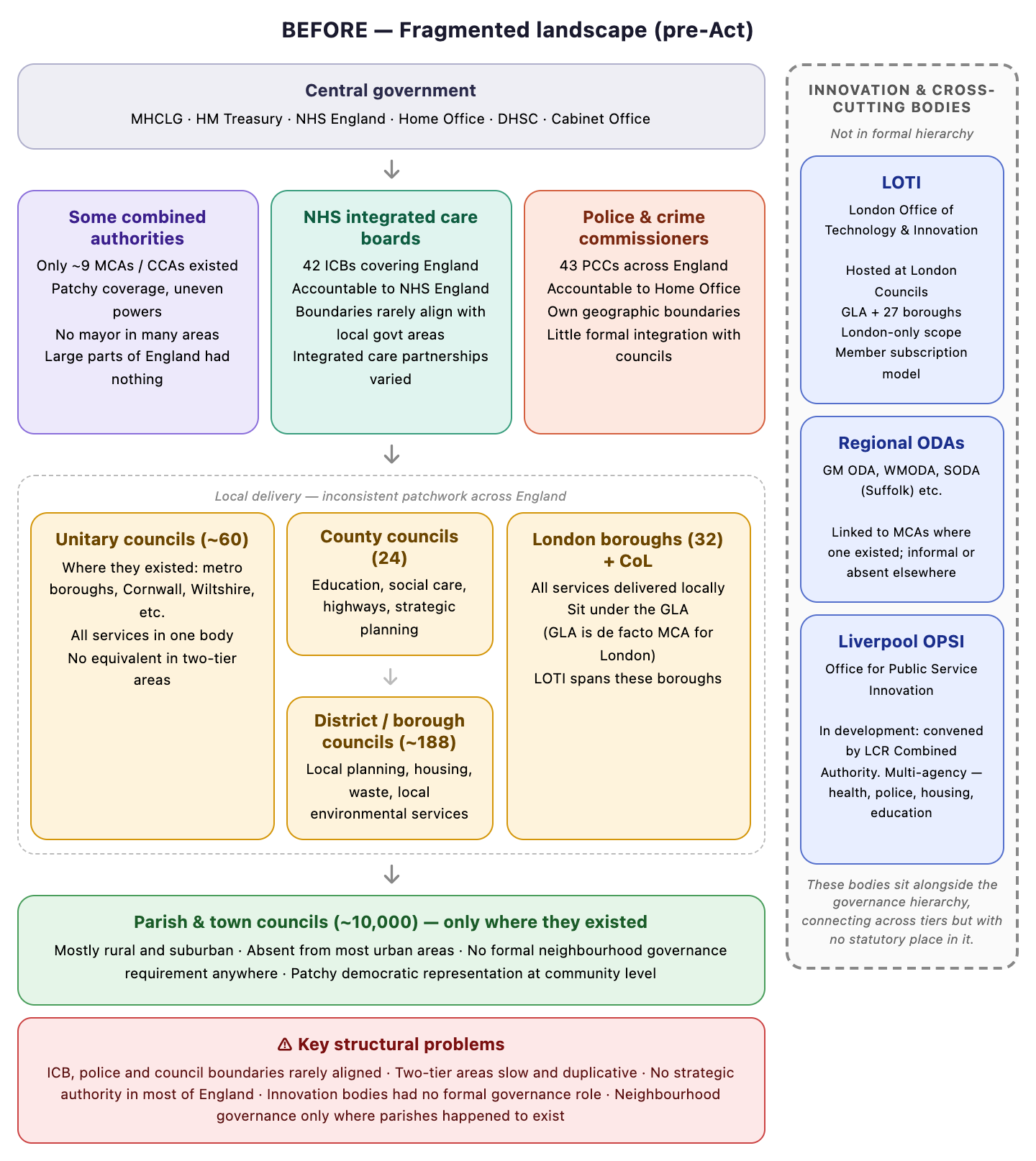
For a start, you need a map. I shamelessly asked Claude to help me draw one. Here’s what the local government picture looks like before the new devolution Act:
And here’s what it is supposed to look like after the Act is implemented:
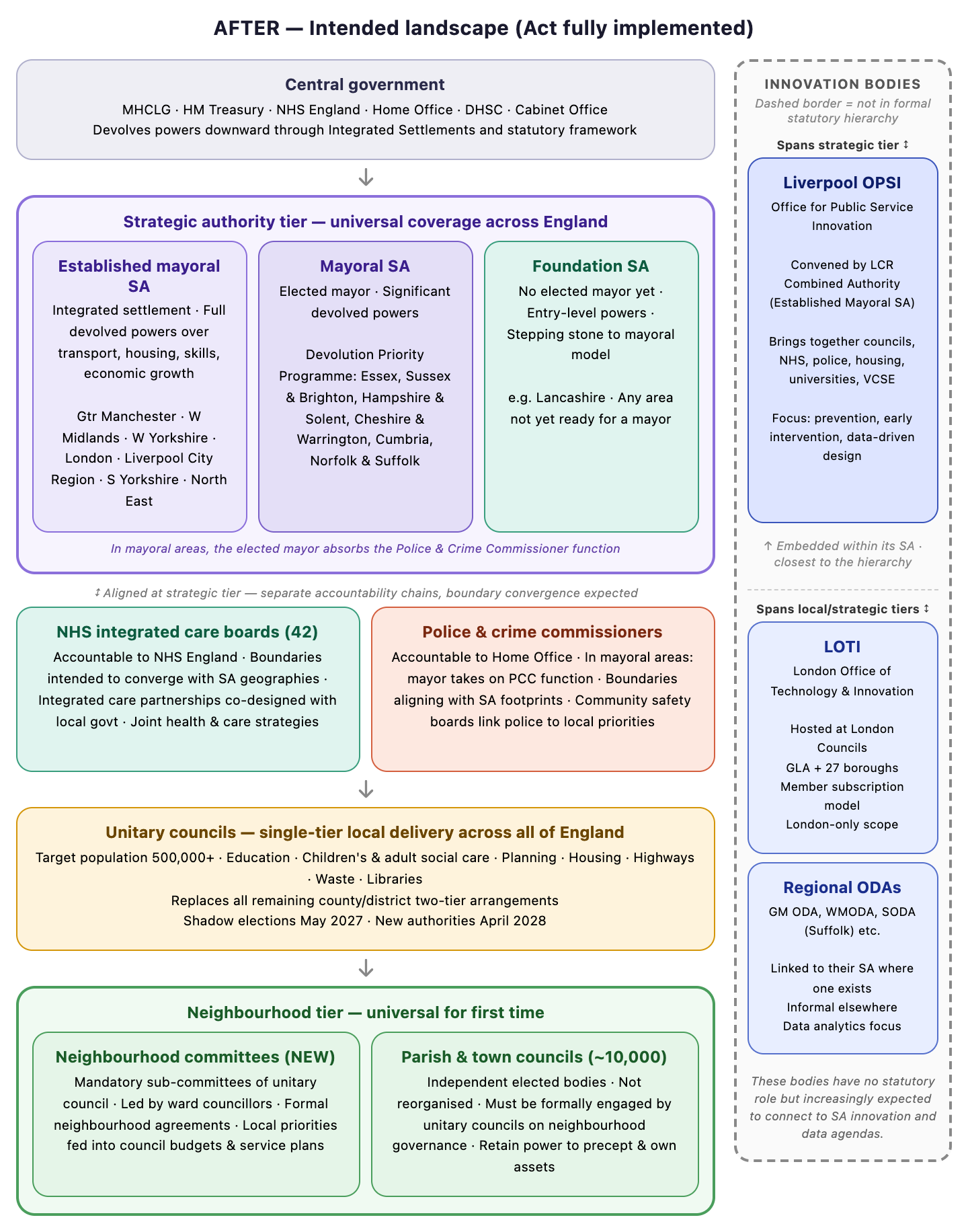
All this is complicated stuff. And this is just a simplified version of a structural, industrial map. Place is clearly much, much more than that. It’s about identities: where do people actually feel like they belong. Those identities do not necessarily map tidily onto administrative or political geographies.
If you try build a movement purely to fit the structure, you are building on ground that means more on paper than it does to people. Having a docking point into how accountability flows is obviously important, but leaving it there leads to a system that just counts beans. To grow beanstalks, it also needs to be built around identity; networks of people who share a sense of common ground and a commitment to similar ways of working. These networks can be more resilient to political change because they do not depend on political structures to exist. They exist because people want them to.
The practical catch is that you cannot really invest in identity. You can invest in structures. If you want to resource something, put money into it, hire people, build institutions - you need something legible and accountable. Goodwill, trust, informal networks, unwritten norms: none of this is very legible, but all of it is vital. A network held together by mutual interest and group chats is not a budget line. This is the central tension, and pretending it is not there will produce bad outcomes.
The answer is probably something like: start with the network, and rapidly earn the structure.
Harking back to GDS again, the original 5-year plan for that team boiled down to 4 steps: create GDS, fix publishing, fix transactions, go wholesale. The first crucial step was to make a start on creating the network of people, and institutional buckets for them to sit in.
That means the first goal of a regional TLG network is to come into existence, to learn how to coordinate, and to agree on a shared organising function. By virtue of being at the centre, it can be a ‘backbone organisation’; one that is intentional about making sure that bits of the country that might otherwise get skipped over don’t get missed (those who aren’t covered by an MSA yet, say). Without putting this deliberate infrastructure in place, the risk is what Bruce Katz and colleagues at New Localism called ‘phone call federalism’ - good ideas spreading only as far as the personal networks of the people who had them.
After that structure is up and running, you can start setting up the functions more fully; maybe as a set of Regional Offices of Technology and Innovation (ROTIs, an acronym that works better than it has any right to). A ROTI wouldn't need to be large - say a handful of people embedded in or alongside an MSA, with a remit to connect local practitioners to the wider network, surface what's making a difference, and making the methodology easy to pick up and use. The Productivity Institute explicitly recommends scaling the OPSI model England-wide and suggests pan-regional or national hosting for them3. Their paper also points out that investing in capacity at this level isn’t a nice-to-have, given a local government workforce that has shrunk by over 30%. The ‘absorptive capacity’ of government to new practices is a binding constraint as to how far and fast it can go in changing how it does things. Whitehall itself is experiencing this right now. The places most in need of support are frequently those with the least headspace and bandwidth to accept it.
How methods travel
Building a movement sounds like a political act. Maybe it is. But there’s nothing to stop technocrats who want change from doing it.
At the top, I mentioned how the TLG programme now reminds me a little of early GDS. In particular, of when GDS was setting up professional communities of practice. These communities - for service design, user research, product management, content design, and so on - didn’t grab a lot of limelight outside their practitioner domains. But they were instrumental in taking the ideas and ways of working incubated within a small central team, and spreading them across a huge, complex, diverse ecosystem of organisations.
TLG is a lot more than just those digital practices. It’s a syncretic mix of digital plus a variety of place-based, relational practices and mindsets that have been used at the edges of the state for some time. Like ‘digital’ or ‘DDaT’, TLG is effectively a brand and banner for a set of practices and ways of working that has a strong system change/public sector innovation flavour. Brands are generally helpful in that they put some edges on things and create a sense of identity to rally a network. By definition, brands and banners also make some people grumpy - I fondly remember the fury from the statistical community about ‘data scientists’, for example. Ultimately, what the brand is matters less than the fact you have one, and there is therefore something for a community to cleave to.
Communities of practice are not always hard to start. You put some willing people in a room, or a Slack channel, and they will dutifully community at each other for a bit. What is hard is maintaining, nurturing and growing such a thing after the initial enthusiasm wanes. For that, you need a coordination layer, and that layer needs three things: artefacts, authority, and attention.
For GDS and the ‘digital’ movement, the artefacts were things like the Service Manual, recruitment guides, and DDaT capability frameworks. These were objects around which new practice could cohere - shared reference points that were easy to copy or follow, and meant someone in HMRC and someone in the Home Office could roughly agree on what good looked like, even if their contexts differed. Writing things down, making them practical and frictionlessly easy to reuse - basic, but extremely important.
The authority came from appointing Heads of Profession posts that were full-time and funded by the centre. Running communities started as side of the desk work in truth; it was quickly apparent that wouldn’t scale. Those leaders had the credibility, the networks, the professional pulling power that encouraged a following from practitioners across and beyond government. But they also needed time and space. So ‘Heads of’ became real roles, their role as nodes of a network became ‘official’. They made the difference between a community that met to share war stories and one that actually changes how things are done. The quality, credibility and drive of those individuals is the single biggest determinant of their success and scale.
And the attention was about who convened the community, and how. The shift that mattered was from author to editor. Those heads of profession in the centre stopped trying to think of everything themselves and started trying instead to curate, connect, and coordinate learning from across the network. It became a node, not a broadcaster. The job was less about producing the definitive answer and more about creating the conditions in which better answers could emerge and spread.
This was the network model that got a set of digital practices out of a small central team and woven into the 450,000-strong Civil Service. It was not perfect, nor frictionless. But it got there to an extent that would have seemed unbelievable in 2011.
Where to begin
Creating an enduring movement for doing things differently means balancing on a very thin tightrope. Not going for central imposition, but not letting a thousand flowers bloom either.
Chipping away at a political culture that goes back several decades is an intimidating task. But it can begin with small bites. Fund a TLG post in every MSA from a central pot, and get people in place by this autumn; give them the brief to share learning across their patches and with each other. Stand up small teams in each MSA to get working on real local challenges using the TLG methodology. Don’t impose it - MSAs can opt-in to the funding and hiring support - and start with those areas who are willing but not yet leading. Start to build a long-term financial case getting buy-in from the powers that be in HMT, Cabinet Office and MHCLG. A credible case for investment needs a scope that is honest about what is being bought: not a guarantee of outcomes, but a set of conditions in which better outcomes become much more likely. That is a harder sell than a delivery programme based on false certainty, but it is the honest one.
Start with the network. Earn and embed the structure. Fund posts. Trust the edges. None of this is glamorous, and most of it will happen without much fanfare.
The centre is not enough. But used well, it can move mountains. It must.
Nesta kindly supported us to do this.
This blog post is my personal view, not those of PD or the TLG programme.
The academic case for pan-regional hosting is fair, but the cultural and relational case for local rootedness feels at least equally strong to me. Your mileage may vary though.
Hi Andrew, we never directly intersected, but I was part of the UKgovcamp network until our Brexodus. And we moved right from the centre to the very far edges.
My niche was always what you may call "Computer Supported Collaborative Work" - except we never called it thus, because the entire early internet was about collaboration. In my past nine years in Germany I observed people in large organisations acting very differently from what we assumed. In your article, you mention some of this.
Service Design was the discipline I absorbed from that scene: designing with the people who use a thing, not for them. It's the lens I've looked at German organisations through for nine years, and what it shows up is the gap your piece circles without quite naming.
Your artefacts / authority / attention have built brilliant communities of practice. I've watched it work. But at the edges, where I am now, the artefacts arrived without the substance: service manuals, capability frameworks. All of them describe what good looks like. None of them designs the structure through which we communicate with other practitioners, but also with the frontline workers who do the testing we aim to learn from.
So I'd propose a fourth A: architecture. It turns out to be a discipline in its own right, not owned by any of the fields that border it, with decades of research behind it (Susan Leigh Star's "infrastructuring", Peter Drucker's Knowledge Work,)
I named it Collaboration Architecture and recently took the argument through peer review in Touchpoint, the journal of Service Design. Your piece is the clearest statement I've seen of the problem it exists to solve, from someone who doesn't yet have the word for it. Which I mean as the compliment it is.
Very interesting, and puts a structure to some of the things that would help engage the public in the process of improving local services. At present we are assumed to be passive consumers of local (and national) politics, with little or no sense of agency to have much influence over the environment we live in. (Try ringing the council to sort something out, or count how many people turn up to the hustings for local elections.)
I’m always struck by the example of Rwanda’s Umuganda Day, where on the last Saturday of the month everyone in a community gives three hours in the morning to help make their local area nicer - cleaning up rubbish, sweeping pavements, fixing things that have broken, planting trees, etc.
Yes, it’s compulsory - a sort of national service - but even the President does his communal bit every month. I can’t see any UK politician advocating this, but starting to develop more local engagement (and perhaps a sense of shared civic responsibility) would seem to be a necessary start…